
Image created by Microsoft Copilot
In part two of four weekly blog posts on intimate partner violence (IPV) during Domestic Violence Awareness Month, I offer a glimpse into the diversity of experiences people may have with intimate partner violence. The purpose of this post coupled with last week’s post providing IPV data and insights is to highlight how widespread, individual, and complex instances of IPV may be.
Complexity in Relational Dynamics
Since it is a difficult topic to discuss that comes with stigma, we may not only silence ourselves but may also minimize our experiences with IPV when they occur. Due to complex relational dynamics, partners themselves, individual or couples' therapists, and/or family and friends may not recognize harm is at play. At times, partners in high conflict who enter couples or partner counseling may enter the work and be viewed as being caught in a power struggle. As a result, IPV may go undetected under the guise of a power struggle. This is a valid and serious concern on its own but often not accompanied by physical, sexual, or psychological aggression or coercion.
Challenging Assumptions
Society may suggest there is a main aggressor and victim with polarization of who can receive support without judgment. In reality, sometimes the partner who tends to receive harm may create harm and vice versa. It is not as simple as society may suggest.
Those who may tend to experience harm are often referred to as “victims” and “survivors” and tend to receive more support and resources. Those who may tend to create harm are often referred to as “offenders” or “perpetrators” and may be ostracized or denied when they try to get help. It takes empathic understanding and addressing both sides and shifting roles to reduce instances of IPV in our homes and communities.
Predictors for IPV
In the first post, I touched on how IPV commonly originates from experiences with abuse, neglect, and invalidating environments at a young age where violence may have been normalized. We may later seek out these power and control dynamics in our intimate relationships to either reenact them or resolve them, and this often happens unconsciously.
We may seek to have power and control over others or over us, and we may find ourselves in cycles of power and control. Sometimes the anxiety and pain of avoidance and withdrawal from a partner can be enough for one who tends to receive harm to create conflict and re-enter the cycle to feel temporarily connected and less anxious. However, this is ultimately an avoidance behavior that perpetuates rather than reduces attempts at power and control.
Power and Control Wheel
Below you can find a range of lived experiences along the Power and Control Wheel, which was originally developed by the Domestic Abuse Intervention Project and adapted by SAVE: Stop Abusive and Violent Environments. Please note the adapted wheel by SAVE is more gender-inclusive to consider who creates or receives harm but may not yet include the full range of gender, sexual, kink, and polyamorous relationships. A gender, sexual, and kink-affirming view has been offered here by Mx. Love C. Dialogos, LMFT.
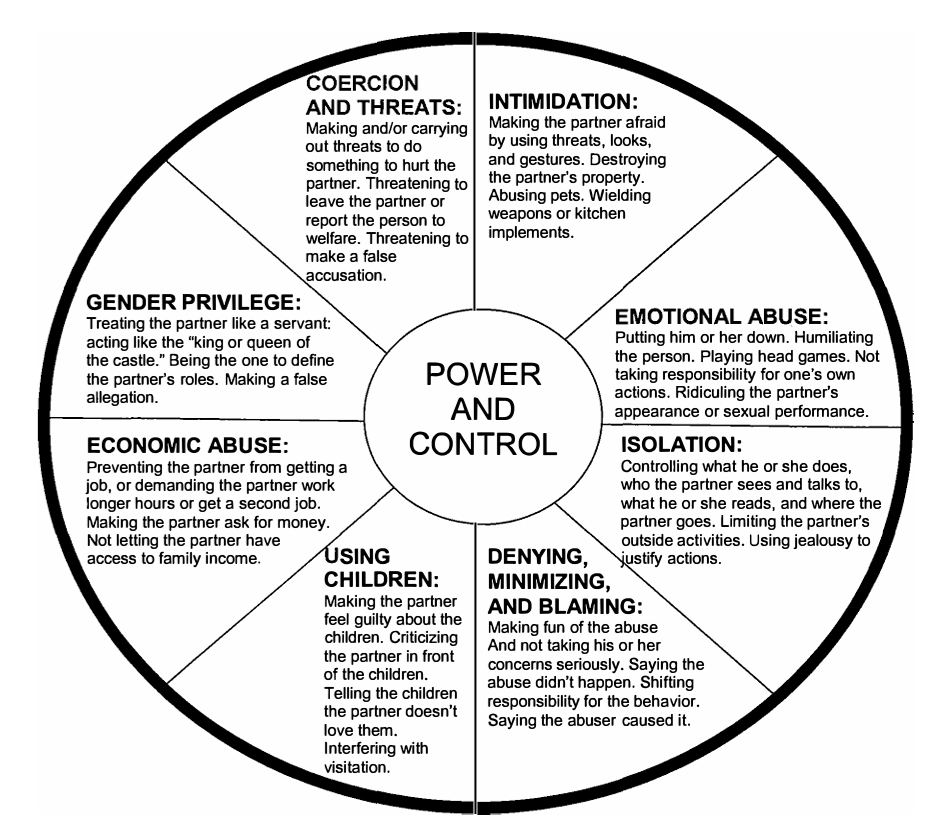
Adapted Power and Control Wheel by SAVE: Stop Abusive and Violent Environments
Diversity of Experiences with IPV
What harm looks like may vary for each partnership based on prior experiences, various identities with more privilege or marginalization, and behaviors that have been normalized. Measures used for power and control may vary accordingly to who is creating and receiving harm at any moment. One’s intimate partner may physically or sexually abuse their partner with physical evidence of harm. Another’s partner may use emotional abuse with no evidence of harm, which creates complexity with law enforcement and legal systems that prioritize physical harm. Another partner may institute financial abuse and restrict resources or access to transportation to go to work. One may withhold their children in divorce or commit parental alienation to turn their children against them. The issue is complex and mulit-layered. The main way to understand it is to examine it directly.
Getting Unstuck
There may be something deeply painful, multi-directional, and intergenerational at the core of experiences with IPV. Partners, or at least one of the partners, coming to therapy may be seeking to get unstuck from their dynamic, whatever it may be. Each partner may need to take a deeper look at instances when they have been in one, the other, or both roles of experiencing or creating harm to better understand what role they play in the dynamic when and how it is maintained. Only then can the cycle be interrupted.
Resources for Support Seekers and Supporters
As mentioned last week, there is support available for those experiencing or observing intimate partner violence. Medical and mental health providers and dedicated hotlines can be a resource for anyone in or observing these situations. You do not have to experience this or witness it in silence or alone. Together we can break the silence by knowing more what is behind intimate partner violence and learning how to interrupt the patterns.
Crisis
If you or someone you know is experiencing an urgent need or an emerging crisis where there is a concern about the personal health or safety for you or others, please call 911 or go to the nearest emergency room.
You may also call National Suicide Prevention at 1-800-273-8255 or text SAFE to 741741.
For local support in Washington state, you may also call the King County Crisis Line at 206-461-3222.
National Domestic Violence Hotline
If you or someone you know is experiencing IPV, the confidential 24/7 National Domestic Violence Hotline is available through multiple methods:
Call 1-800-799-SAFE (7233)
Test “START” to 88788
Visit Domestic Violence Support | National Domestic Violence Hotline for a live chat
A Look Ahead to Week 3
Next week I will share more about the role, ethical duty, and support for mental health professionals in identifying, conceptualizing, and treating intimate partner violence. The main idea to plant here ahead of next week is we cannot assume we know what a partner or partners experience, preferences for keeping or dissolving the relationship, or needs for support without asking and listening deeply.
As therapists, we need to remain free of judgment and provide ethical and equitable treatment to all clients, whatever side of this issue they may be on. We also may know this may not be an easy topic to support, and it may come up from a partner or partners without warning. It is our responsibility to develop knowledge, skills, and competence for a range of concerns clients may bring to us along with seeking our own supervision and consultation and preparing referral and resource lists when we find ourselves beyond our scope of practice and competence.